The Inner Circle refers to the countries where English is used as the mother tongue.
Speakers from England carried the language to North America, Australia, and New Zealand.
The Outer Circle refers to the countries where English is not the native tongue, but serves as one of the official languages.
Such countries include India, Pakistan, Singapore, Kenya, and South Africa.
The Expanding Circle consists of countries where English plays no historical or official role, but is widely used as a medium of international communication.
This includes many of the remaining countries such as Korea, China, Egypt, Norway, and Russia.
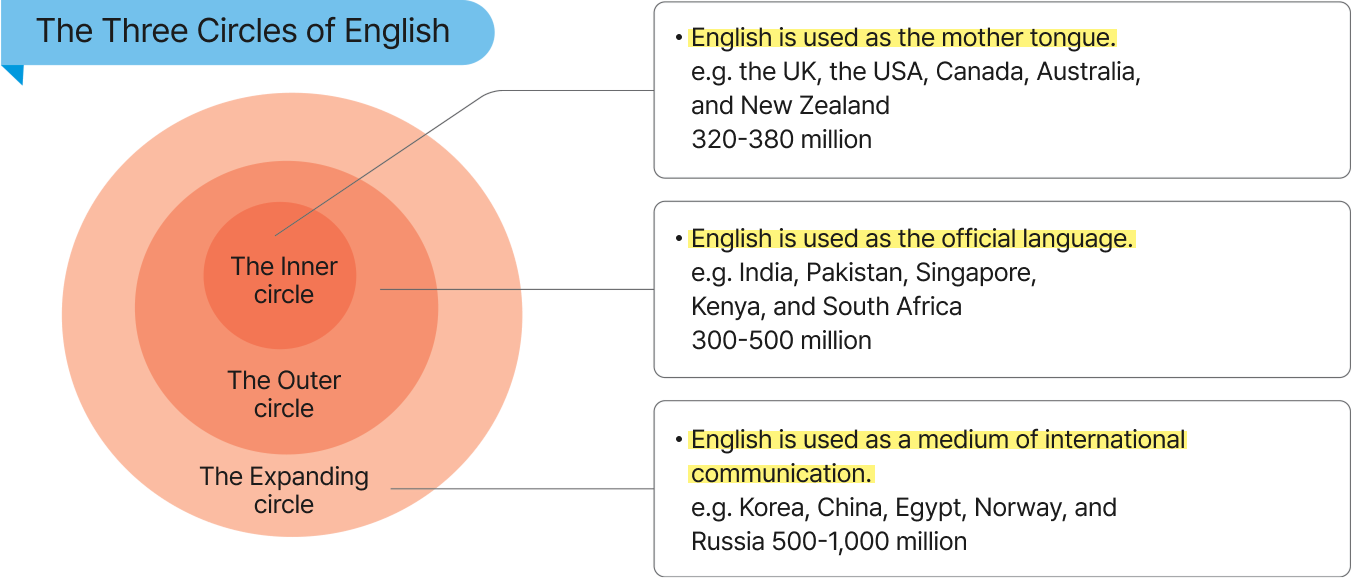
Kachru’s model helps us understand the global variations and functions of English as a language.

Read 2 해석

The Inner Circle refers to the countries where English is used as the mother tongue.
내부 원은 영어가 모국어로 사용되는 국가들을 가리킵니다.
Speakers from England carried the language to North America, Australia, and New Zealand.
영국의 사용자들이 이 언어를 북미, 호주, 뉴질랜드로 전파했습니다.
The Outer Circle refers to the countries where English is not the native tongue, but serves as one of the official languages.
외부 원은 영어가 모국어가 아니지만, 영어가 공식 언어로 사용되는 국가들입니다.
Such countries include India, Pakistan, Singapore, Kenya, and South Africa.
이러한 국가들에는 인도, 파키스탄, 싱가포르, 케냐, 남아프리카공화국이 포함됩니다.
The Expanding Circle consists of countries where English plays no historical or official role, but is widely used as a medium of international communication.
확장 원은 영어가 역사적이거나 공식적인 역할을 하지 않지만, 국제 의사소통의 매개체로 널리 사용되는
국가들입니다.
This includes many of the remaining countries such as Korea, China, Egypt, Norway, and Russia.
여기에는 한국, 중국, 이집트, 노르웨이, 러시아 등의 국가가 포함됩니다.
전체 해석보기
문장별 해석보기
Words & Phrases
  • refer to
    v. ~을 가리키다, 의미하다
    to mean or describe something
    e.g.
    The word “emoji” refers to small digital images used in online messages.
    ‘이모지’라는 단어는 온라인 메시지에서 사용하는 작은 디지털 그림을 가리킨다.
  • variety
    n. 다양성, 여러 종류
    a number of different types of something
    e.g.
    There are many varieties of English around the world.
    세계에는 다양한 종류의 영어가 있다.
  • spread
    v. 퍼지다, 번지다
    to cover or reach a larger area
    e.g.
    Social media helps spread new cultural trends around the world.
    소셜 미디어는 새로운 문화적 유행이 전 세계로 퍼지도록 돕는다.
  • in terms of
    phr. ~의 관점에서, ~에 관하여
    used to describe something from a particular point of view
    e.g.
    The two smartphones are similar in terms of design and performance.
    그 두 스마트폰은 디자인과 성능 면에서 비슷하다.
  • expand
    v. 확장하다, 늘리다
    to become larger or more important
    e.g.
    The company plans to expand its business to several Asian countries.
    그 회사는 사업을 여러 아시아 국가로 확장할 계획이다.
  • the mother tongue
    n. 모국어
    the first language a person learns as a child
    e.g.
    Spanish is the mother tongue of many people in Mexico.
    스페인어는 멕시코의 많은 사람들의 모국어이다.
  • serve
    v. 역할을 하다; 도움이 되다
    to be useful or helpful for a particular purpose
    e.g.
    The community center serves as a safe place for teenagers after school.
    그 지역 사회 센터는 방과 후 청소년들에게 안전한 공간의 역할을 한다.
  • play a role
    v. 역할을 하다
    to have an effect or influence on something
    e.g.
    Parents play an important role in their children's learning.
    부모는 자녀의 학습에서 중요한 역할을 한다.
  • include
    v. 포함하다
    to have something as a part of a whole
    e.g.
    The travel package includes a hotel stay, breakfast, and a city tour.
    그 여행 패키지는 호텔 숙박, 아침 식사, 시티 투어를 포함하고 있다.
  • medium
    n. 매체, 매개(물)
    a way of sharing information or ideas
    e.g.
    Film is a powerful medium for sharing cultural stories with people.
    영화는 문화 이야기를 전달하는 강력한 매체이다.
  • refer to
  • variety
  • spread
  • In terms of
  • expand
  • the mother tongue
  • serve
  • play a role
  • include
  • medium
듣기