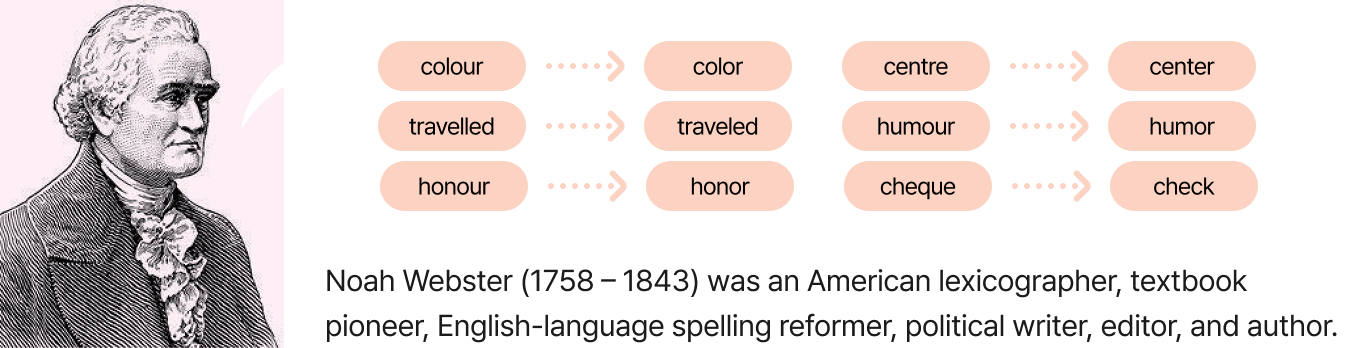
After gaining political independence from Britain, America also wanted to achieve linguistic independence.
Noah Webster proposed a spelling reform and his proposals were contained in his dictionary published in 1828.
His new spellings were: -er for -re (e.g. theater/ theatre, center/centre), -or for -our (e.g. labor/labour, color/colour), -k for -que (e.g. check/cheque), single -l before a suffix (e.g. traveled/ travelled).
These changes became standard features of American English spelling, which explains why these words are spelled differently in British and American English.
Later, waves of immigrants from Europe arrived in America and the languages they spoke added many new words to English.
Examples of these words include: boss and cookie from Dutch; chowder and bureau from French; hamburger, kindergarten and allergy from German; and spaghetti and pizza from Italian.