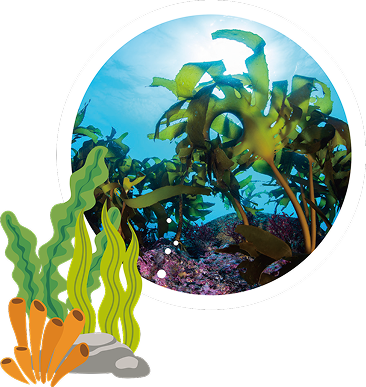
Carbon Footprint Lower than Vegetables
First of all, seaweed is a food that can be produced in a
sustainable way.
sustainable way.
It is rich in dietary fiber, protein, and
minerals, almost as much as vegetables, but its carbon
footprint is lower than that of vegetables.
minerals, almost as much as vegetables, but its carbon
footprint is lower than that of vegetables.
Moreover, it
possesses a significant ability for carbon dioxide
absorption.
possesses a significant ability for carbon dioxide
absorption.
An analysis of 16 types of seaweed that live
in the coastal forest showed that the amount of carbon
dioxide absorbed by one ton of seaweed per hour is more
than three times the carbon dioxide absorption rate of trees.
in the coastal forest showed that the amount of carbon
dioxide absorbed by one ton of seaweed per hour is more
than three times the carbon dioxide absorption rate of trees.
First of all, seaweed is a food that can be produced in a sustainable way.
a food를 선행사로 하는 주격 관계대명사 that이 사용되었다.
~ but its carbon footprint is lower than that of vegetables.
that은 앞에 나온 carbon footprint를 의미한다.
An analysis of 16 types of seaweed that live in the coastal forest showed that the amount of carbon dioxide absorbed by one ton of seaweed per hour is more than three times the carbon dioxide absorption rate of trees.
첫 번째 that은 16 types of seaweed를 선행사로 받는 주격 관계대명사이고, 두 번째 that은 접속사로 showed의 목적어 역할을 하는 명사절을 이끌고 있다.