
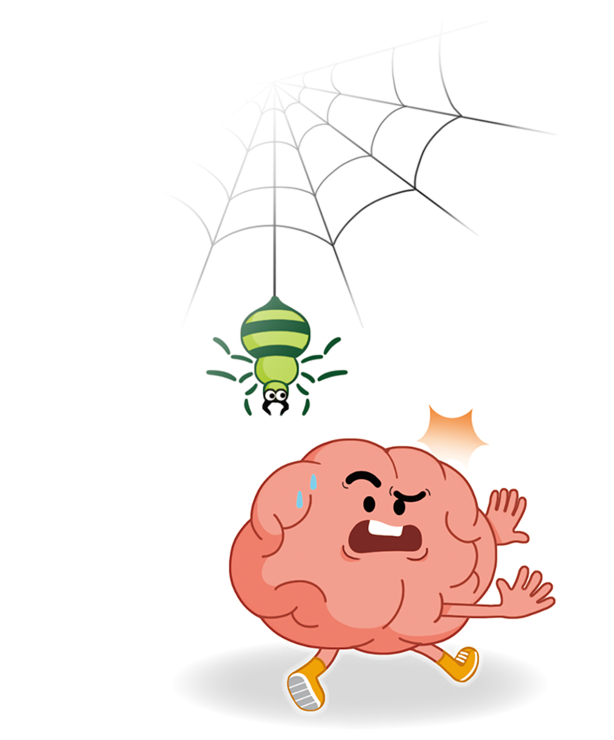
Where does fear come from and what makes my
body react in such ways when I am afraid?

Fear is an emotion made by a particular part of the brain.
This
part constantly scans information from your senses — the
things you see, hear, and feel.
When your brain recognizes
a similar situation to one stored as a memory, however trivial
it is, it brings up those same feelings that are attached to the
memory.
It stores memories of danger and whether what you
did (like running away) helped or made things worse.
These
memories help the brain make very fast decisions about how
to respond to threats.
Fear is an emotion made by a particular part of the brain.

an emotion과 made by 사이에 that[which] is가 생략되었다.

When your brain recognizes a similar situation to one stored as a memory, however trivial it is, it brings up those same feelings that are attached to the memory.

one은 situation의 반복을 피하기 위한 부정대명사이며, however는 ‘아무리 ~할지라도’의 의미인 복합관계부사로서 뒤의 trivial을 수식하며, no matter how로 바꾸어 쓸 수 있다.

It stores memories of danger and whether what you did (like running away) helped or made things worse.

stores의 목적어로 memories of danger와 whether가 이끄는 명사절이 사용되었다. 「whether A or B」는 ‘A인지 B인지’의 뜻으로 여기서는 ‘여러분의 행동이 도움이 되었는지 혹은 상황을 악화시켰는지’를
나타낸다.

Even though the repair wasn’t perfect, it worked and allowed me to continue my travels without any issues.

stores의 목적어로 memories of danger와 whether가 이끄는 명사절이 사용되었다. <whether A or B>는 ‘A인지 B인지’의 뜻으로 여기서는 ‘여러분의 행동이 도움이 되었는지 혹은 상황을 악화시켰는지’를 나타낸다.

Read 해석

Q: Where does fear come from and what makes my body react in such ways when I am afraid?
Q: 두려움은 어디에서 오며, 두려움을 느낄 때 내 몸이 그런 방식으로 반응하는 이유는 무엇인가요?
A: Fear is an emotion made by a particular part of the brain.
A: 두려움은 뇌의 특정 부분에 의해 만들어지는 감정입니다.
This part constantly scans information from your senses — the things you see, hear, and feel.
이 부분은 여러분의 감각으로부터 정보를 끊임없이 훑어봅니다. 여러분이 보고, 듣고, 느끼는 것들 말입니다.
When your brain recognizes a similar situation to one stored as a memory, however trivial it is, it brings up those same feelings that are attached to the memory.
여러분의 뇌가 하나의 기억으로 저장된 상황과 유사한 상황을 인식할 때, 그 상황이 아무리 사소하더라도, 뇌는
그 기억에 연결된 같은 감정을 불러일으킵니다.
It stores memories of danger and whether what you did (like running away) helped or made things worse.
뇌는 위험에 대한 기억과 여러분이 했던 행동(도망치는 것 같은)이 도움이 되었는지 혹은 상황을 악화시켰는지를
저장합니다.
These memories help the brain make very fast decisions about how to respond to threats.
이러한 기억들은 뇌가 위협에 어떻게 반응할지를 빠르게 결정할 수 있도록 돕습니다.
전체 해석보기
문장별 해석보기

Paragraph Summary

After self-reflection, I learned the importance of valuing items and started to
repair
and
trade
in them.

Reading Strategy

Identify the sequence of events from July 8th to 10th, leading up to the completion of the rescue operation.
However, simply pumping out the water was not enough. The forecast predicted heavy rains in the coming days, putting the rescuers on high alert. Thus, a final but risky decision was made to take the “Wild Boars” out of the cave in groups of three or four boys at a time. the boys and their coach went deeper and deeper into the cave, ending up in a chamber about 4 km from the entrance to the cave.

On July 8th, the mission took off. To prevent panic in the tight, underwater passages, the boys were fitted with full-face breathing masks. The divers held them close and were guided through the darkness by dive lines. After the flooded section, the boys were either carried on special beds or lifted up along ropes. After a long, nerve-wracking 11 hours, the rescue team successfully emerged with the first four boys. Four more boys were rescued the following day.

Finally, on July 10th, the last four boys and the coach were brought to safety. The world rejoiced at their rescue, and the boys and their coach were immediately transported to a hospital, where they were kept separated from others to prevent any potential infections. Once the doctors confirmed their good health, the boys were able to return home and reunite with their families.
듣기