Paragraph 3
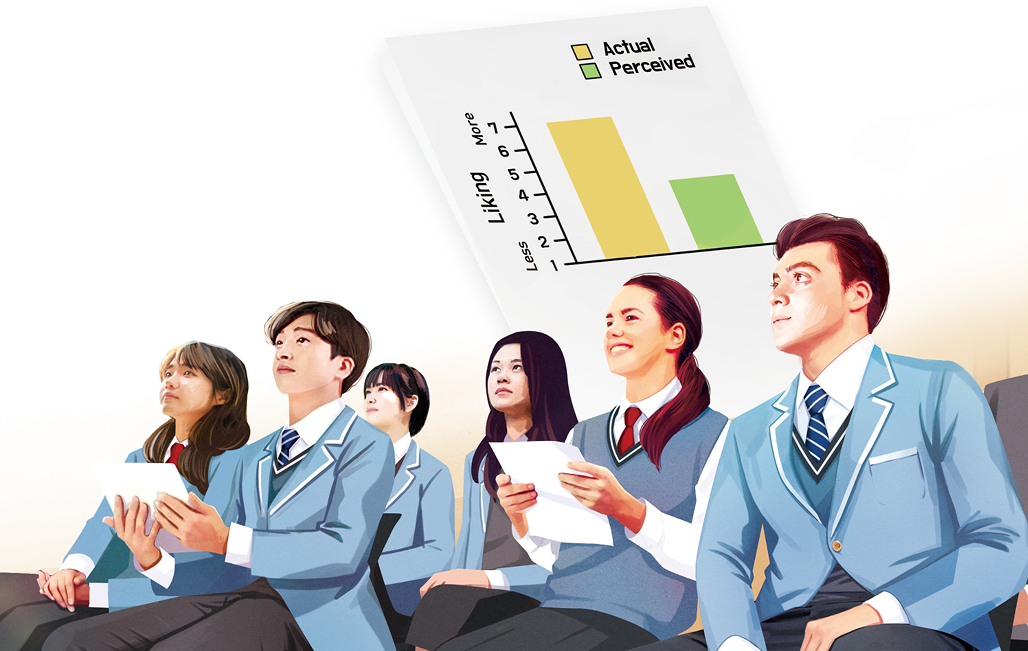
The researchers coined a new term, the “liking gap,” for this difference in perception or the mismatch between how we perceive ourselves and what others actually think of us.
How is this helpful for you?
We often underestimate ourselves based on our assumption of
how others might judge us.
In other words, our fixed attitudes may prevent us from reaching our true potential.
Don’t worry about the impression you think you make on people;
chances are you can be confident that the impression you make is just fine.
chances are = probably
The researchers coined a new term, the “liking gap,” for this difference in perception or the mismatch between how we perceive ourselves and what others actually think of us.

between A and B 구조가 사용되어 how we perceive ourselves와 what others actually think of us가 대등하게 연결되어 있다.

chances are you can be confident that the impression you make is just fine

chances are (that)~은 ‘아마도 ~일 것이다’의 의미를 가진 관용구이며, 접속사 that은 생략되었다.

Additionally, researchers asked participants if they thought their partners liked them.

if they thought their partners liked them는 asked의 직접목적어인 명사절로 if는 ‘~인지’의 의 미를 나타내는 접속사이다. their partners liked them는 thought의 목적어인 명사절로, 접속사 that은 생략되었다.

Most participants’ estimations of their partners’ responses were pessimistic, which were opposite to the real responses.

Most participants’ estimations of their partners’ responses는 문장의 주어 역할을 하는 명사구로, 주어의 핵이 복수형 명사인 estimations이므로 술어동사는 were이 쓰였다. which were opposite to the real responses는 Most participants’ estimations of their partners’ responses을 부가적으로 설명하는 관계절이다.

It turns out that participants do not make bad impressions but make better impressions than they think.

It은 형식상의 주어이고 that 이하가 내용상의 주어이다. ‘A가 아니라 B’의 뜻인 not A but B 구조가 사용되어 make bad impressions와 make better impressions than they think가 but으로 대등하게 연결되어 있다.

Read 해석

The researchers coined a new term, the “liking gap,” for this difference in perception or the mismatch between how we perceive ourselves and what others actually think of us.
연구자들은 이러한 인식의 차이 또는 우리가 우리 자신을 어떻게 인식하는지와 다른 사람들이 실제로 우리를
어떻게 생각하는지 간의 불일치에 대해 “호감 격차”라는 새로운 용어를 만들었습니다.
How is this helpful for you?
이것이 당신에게 어떻게 도움이 될까요?
We often underestimate ourselves based on our assumption of how others might judge us.
우리는 흔히 다른 사람이 우리를 어떻게 판단할지에 대한 추정에 근거하여 우리 자신을 과소평가합니다.
In other words, our fixed attitudes may prevent us from reaching our true potential.
다시 말해, 우리의 고정된 태도는 우리가 진정한 잠재력에 도달하는 것을 막을 수 있습니다.
Don’t worry about the impression you think you make on people;
여러분이 사람들에게 준다고 생각하는 인상에 대해 걱정하지 마십시오.
chances are you can be confident that the impression you make is just fine.
아마 당신이 주는 인상은 그냥 괜찮다고 확신해도 될 겁니다.
전체 해석보기
문장별 해석보기
듣기